A ChangeTower alternative built around understanding what changed
ChangeTower is built around archiving and compliance: timestamped snapshots of what a page said, team seats and role-based access on every plan, and a free tier that doesn't expire. PageDiff is built around understanding. You describe what to watch in plain English, and each alert is an AI summary with a graded significance score, sent from EU-hosted infrastructure. The sharpest practical difference is the feature ladder: with ChangeTower, watching one section of a page starts at $36/month and ignoring an element at $78/month, where every PageDiff plan is fully featured. If your job is keeping a defensible archive of what a page used to say, ChangeTower is the more purpose-built tool.
ChangeTower is aimed at compliance, legal and PR teams: monitor a page, archive the history, prove what it said on a given date. PageDiff is aimed at the moment after detection, telling you what changed and whether it's worth your attention. That difference in intent runs through both feature lists, so it's worth reading the table below with it in mind.
| Feature | ChangeTower | PageDiff |
|---|---|---|
| What to watch | Pick keywords or phrases, an HTML snippet, or a visual area of the page, and write custom instructions its AI monitor applies to filter changes. Monitoring a specific page section starts on Essential ($36/mo); ignoring specific elements on Business ($78/mo) | Describe it in plain English, with no CSS selectors or XPath |
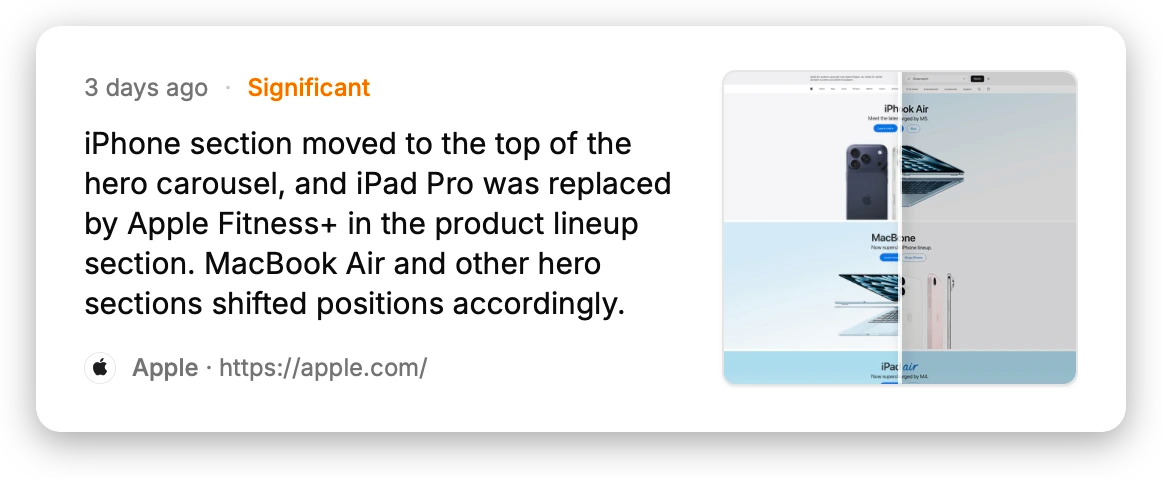
| Change detection | AI-powered monitoring on every plan: it applies the written rules you give it to decide which changes qualify. The alert tells you a qualifying change happened, but there's no AI-written summary of what changed and no graded significance score | AI writes a plain-language summary and scores how significant each change is |
| Alert channels | Email notifications and an in-app activity stream on every plan, plus a Slack integration. SMS, Discord and other destinations go through Zapier, which its help centre says is available to upgraded accounts only | Email, Slack, Discord, and signed webhooks |
| Data residency | ChangeTower LLC is a Chicago, Illinois company; its terms are governed by Illinois law with venue in Cook County. Its privacy policy states you consent to your information being transferred to and stored on its servers located in the United States. We found no GDPR section or description of EU transfer safeguards in the policy as published, which isn't proof none exist, only that they aren't stated there | Hosted in the EU; GDPR-compliant, EU-operated |
| Getting started | A free plan that doesn't expire (3 pages, daily checks, 30-day history), plus a free trial on paid plans. Paid tiers run $12 for 25 pages checked daily to $78 for 200 pages checked every 20 minutes, then custom Enterprise pricing | 14-day free trial of the Starter plan: 10 monitors and 1,000 checks/month |
| Plan differences | A steep ladder. Page-section monitoring, custom user interactions and lazy-loaded content support start on Essential ($36/mo); ignoring specific elements on Business ($78/mo); full-page archiving, domain scanning, multi-region checks and multi-workspace setup are Enterprise-only | Every plan is fully featured; plans differ only by scale |
ChangeTower's details were verified against changetower.com in August 2026, and this comparison is dated so you can see how current it is. Products change, so if anything here is out of date, tell us and we'll correct it.
An archive, or an explanation
ChangeTower’s centre of gravity is the archive. Its own pages sell compliance, legal, PR and brand monitoring, and the product is shaped to match: snapshot a page’s content, code and appearance on a schedule, keep the history, and be able to show what the page said on a date someone asks about. Detection is the front end of an evidence trail.
Setting a monitor up follows from that. You choose the mechanism, whether that’s a keyword or phrase to watch for (present or absent), an HTML snippet, an image, or a visual area, and you can layer on written instructions for its AI monitor, which applies your logic to decide which detected changes actually qualify. It’s flexible, and if you already know the exact mechanism you want, it’s direct.
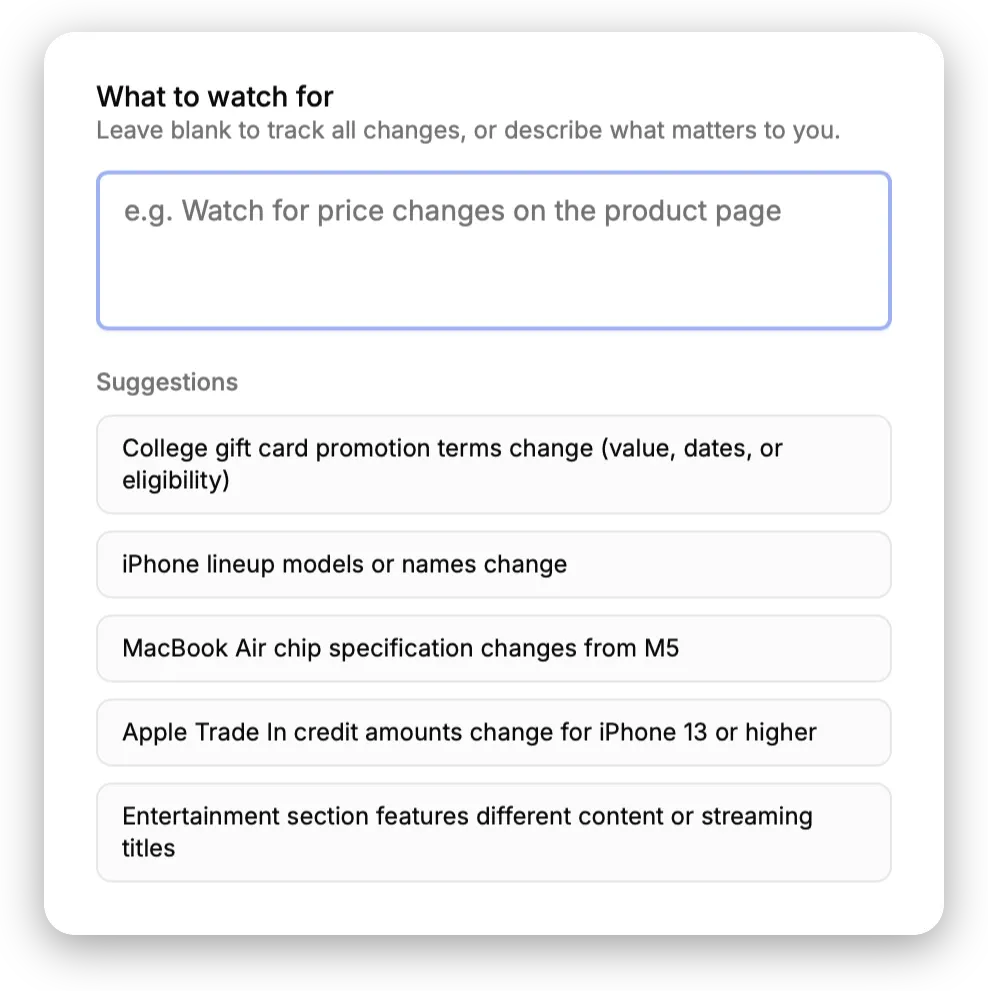
PageDiff starts from a different question: not “which mechanism should I use?” but “what would you actually want to hear about?” You answer in plain English, something like “tell me if the pricing table changes, but ignore the cookie banner and the footer”, and that sentence is the monitor. When the page moves, an AI writes up what happened and scores how much it matters.
Both use AI; they use it at different points. ChangeTower’s AI filters changes against rules you wrote. PageDiff’s AI is how the monitor gets created and how the change gets explained.
Where PageDiff pulls ahead
The feature ladder is the big one. The table above has the tiers; what it can’t show is how those thresholds feel in use. Ignoring an element isn’t an advanced technique. It’s the first thing you reach for when a page has a rotating banner or a live timestamp, and on ChangeTower that’s a $78/month capability. Lazy-loaded content support sits two tiers up as well, and on a JavaScript-heavy site that isn’t optional either. The effect is that the cheap plans are cheap partly because they watch pages bluntly.
Every PageDiff plan is fully featured. Sections, exclusions, AI summaries, significance scoring, every alert channel: all of it, on Starter. Plans differ by scale alone: monitors, checks, frequency, retention.
What lands in your inbox is the second difference. ChangeTower tells you a change matched your criteria; PageDiff tells you what changed, in a sentence or two, and how much it matters. After the tenth footer tweak that stops being cosmetic, because a graded score is what lets you sort and mute alerts instead of reading each one to find out whether you needed to.
Where your data lives is the third. ChangeTower’s privacy policy asks you to consent to your information being transferred to and stored on servers in the United States, and doesn’t set out a GDPR position or EU transfer safeguards. PageDiff is EU-hosted and EU-operated, with snapshots kept under EU jurisdiction. If your procurement review asks where the data sits, that’s a short conversation in one case and a longer one in the other.
Channels, too. PageDiff includes email, Slack, Discord and signed webhooks on every plan. ChangeTower’s own alerting is email plus its in-app activity stream, with a Slack integration; anything beyond that runs through Zapier, which its help centre notes is for upgraded accounts.
Where ChangeTower wins outright
If what you need is a defensible record rather than a good explanation, ChangeTower is the more purpose-built tool:
- Archiving as the product. Timestamped snapshots of content, code and visual appearance, kept as a history you can point at. PageDiff keeps change history too, but archiving isn’t what it’s designed around. If a compliance officer will one day ask “what did this page say in March?”, that’s ChangeTower’s home ground.
- Teams on every plan. Additional team members and role-based access control, included from the free plan up. PageDiff has no team seats today.
- A free plan that doesn’t expire. Three pages, daily checks, no card. PageDiff offers a no-signup preview and a 14-day trial, which is good for evaluating but isn’t a permanent free tier.
- More pages per dollar at volume. If you’re watching a couple of hundred pages once a day, ChangeTower’s per-page cost is hard to beat.
- Adjacent monitoring. Uptime checks, external file monitoring (.css, .js, .html, .txt), domain scanning and multi-region checks on Enterprise. PageDiff watches page content and doesn’t try to be an uptime tool.
Which one is yours?
It comes down to what you want the alert to leave behind. If the answer is a record, dated, archived and shared across a team with role-based access, ChangeTower is built for that job and PageDiff isn’t.
If the answer is a decision, where you describe what matters in plain English and get back a summary and a score telling you whether to look, that’s the case for PageDiff.
Quickest way to tell which you are: point PageDiff at a page you actually care about below, no account and nothing to install, or compare the plans.
Try PageDiff on any page
Paste a public URL to see the live capture and the watch conditions PageDiff suggests, right here, no signup.