A Hexowatch alternative with one monitor type, not thirteen
Hexowatch is the broader tool by a wide margin. It ships thirteen monitor types covering visual, content, HTML element, keyword, source code, tech stack, availability, API, WHOIS, sitemap, backlink, RSS and price changes, it can log into a page with custom actions, and Business plans and up let you run checks from the US, EU or Asia. PageDiff has one monitor type. You describe what to watch in plain English, and every alert comes back as an AI-written summary with a graded significance score. Hexowatch's own AI monitor is an auto-pilot that watches all change types at once rather than a summarizer, so its alert tells you a change was detected and leaves the reading to you. The other split is jurisdiction. Hexact, Inc. is a US corporation whose privacy policy says it primarily stores information in the United States. PageDiff is an EU company hosting in the EU. If you need uptime, WHOIS, backlink or tech-stack monitoring in the same account, use Hexowatch.
These two tools answer different questions. Hexowatch asks which kind of change you want to catch and gives you a monitor built for each kind. PageDiff asks what you'd want to be told and writes the answer for you. That makes most of the feature table below a straight win for Hexowatch on breadth, and the two rows where PageDiff pulls ahead are about what happens after a change is found.
| Feature | Hexowatch | PageDiff |
|---|---|---|
| What to watch | Pick one of thirteen monitor types first, then configure it: part of the screen for the visual monitor, named fields for the HTML element monitor, a keyword list for the keyword monitor. Custom actions can log into a page on paid plans. There is no plain-English condition | Describe it in plain English, with no CSS selectors or XPath |
| Change detection | Every detected change is archived as a snapshot you can compare against the previous one. Its AI monitor is, in Hexowatch's words, "an auto-pilot mode that alerts you when any visual, content, source code, or technology changes are detected": AI that widens detection rather than explaining a change. No written summary, no significance score | AI writes a plain-language summary and scores how significant each change is |
| Alert channels | Wider than PageDiff's: email plus Slack, Discord, Telegram, Microsoft Teams, webhooks, Zapier, Pabbly Connect, Google Sheets export and a REST API. All of it is paid. The free tier has no webhooks, no integrations and no API key | Email, Slack, Discord, and signed webhooks |
| Data residency | Hexact, Inc. is a US corporation and its privacy policy states it "primarily stores information in the United States", under Delaware law. Business plans can pick US, EU or Asia as the check origin, which sets where a page is fetched from, not where your data is kept. The policy names no EU transfer mechanism, which isn't proof none exists, only that it isn't stated there | Hosted in the EU; GDPR-compliant, EU-operated |
| Getting started | A free tier at $0 with 75 checks a month, capped at one check every 12 hours. Paid plans are $29/month for 4,500 checks, $55 for 10,000 and $99.99 for 25,000, annual billing discounted, Enterprise by enquiry. Plans meter checks, not pages: their own worked example is 720 checks a month for one page checked hourly | 14-day free trial of the Starter plan: 10 monitors and 1,000 checks/month |
| Plan differences | Capability is tiered. Webhooks, integrations, custom actions and the API start at Pro ($29); selectable US, EU and Asia check locations at Business ($55). The shortest check interval runs 12 hours on the free tier, 15 minutes on Pro, 5 minutes on Business | Every plan is fully featured; plans differ only by scale |
Hexowatch's details were verified against hexowatch.com in September 2026, and this comparison is dated so you can see how current it is. Products change, so if anything here is out of date, tell us and we'll correct it.
First you pick a monitor type
Hexowatch’s first screen asks you to choose. Visual, content, HTML element, keyword, source code, technology, availability, API, WHOIS, sitemap, backlink, RSS or price: pick the monitor that matches the kind of change you’re after, then configure it. It’s a genuinely capable spread, and several of those monitors have nothing to do with page content at all. Watching a domain’s WHOIS record or a partner’s backlink is a different job that happens to live in the same product.
The choice is also the catch. You have to know in advance which type of change you’re waiting for. A competitor who rewrites a plan name is a content change; one who swaps the pricing widget is a source-code change; one who quietly drops a plan may be both. Hexowatch’s answer to that is the AI monitor, an auto-pilot that watches visual, content, source code and technology at once so you don’t have to pick. That solves the guessing. It doesn’t help with what arrives afterwards, which is a notification that something moved on the page.
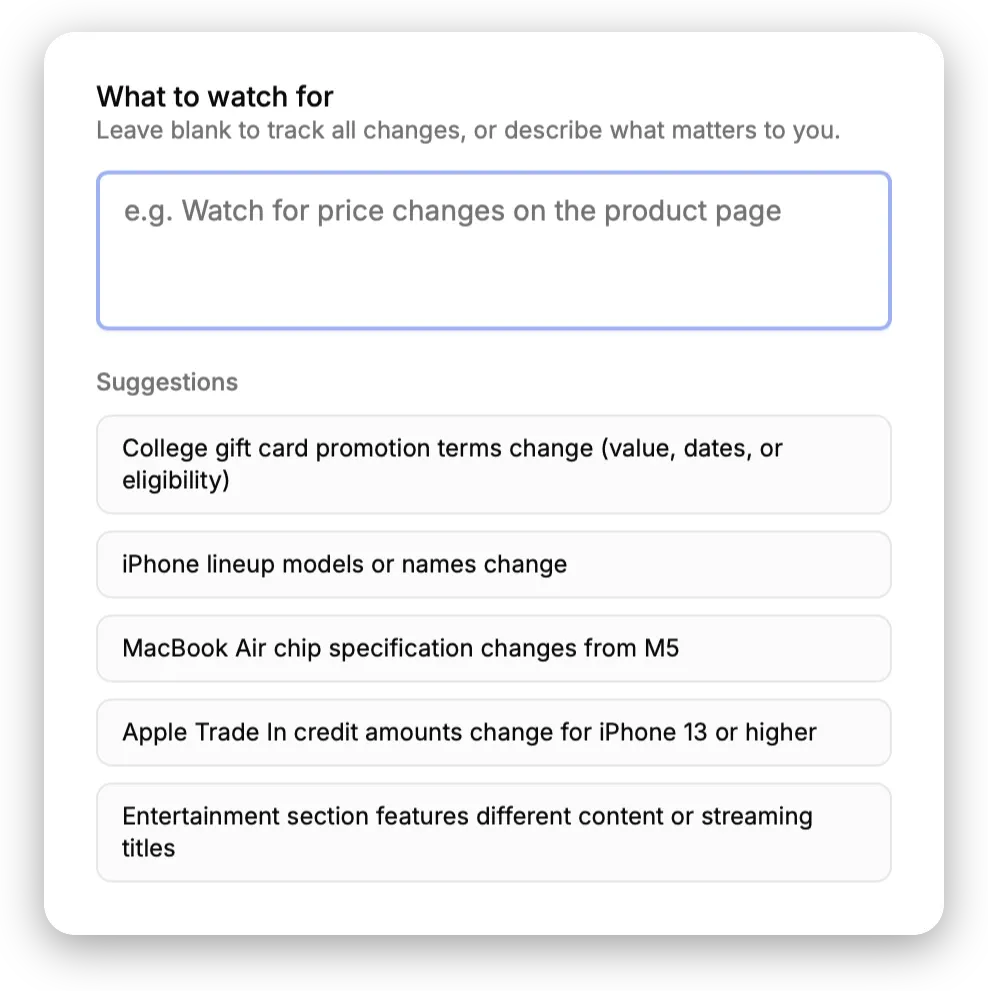
PageDiff asks one question instead. You describe what you’d want to be told, in a sentence like “tell me if the pricing table changes, but ignore the cookie banner and the footer”, and that sentence is the monitor. There is no type to choose and nothing to configure past the schedule and the channel.
What PageDiff does instead
The description is the monitor. No monitor type, no element to select, no keyword list. If the page you care about is one you’d struggle to classify, that’s the case this is built for.
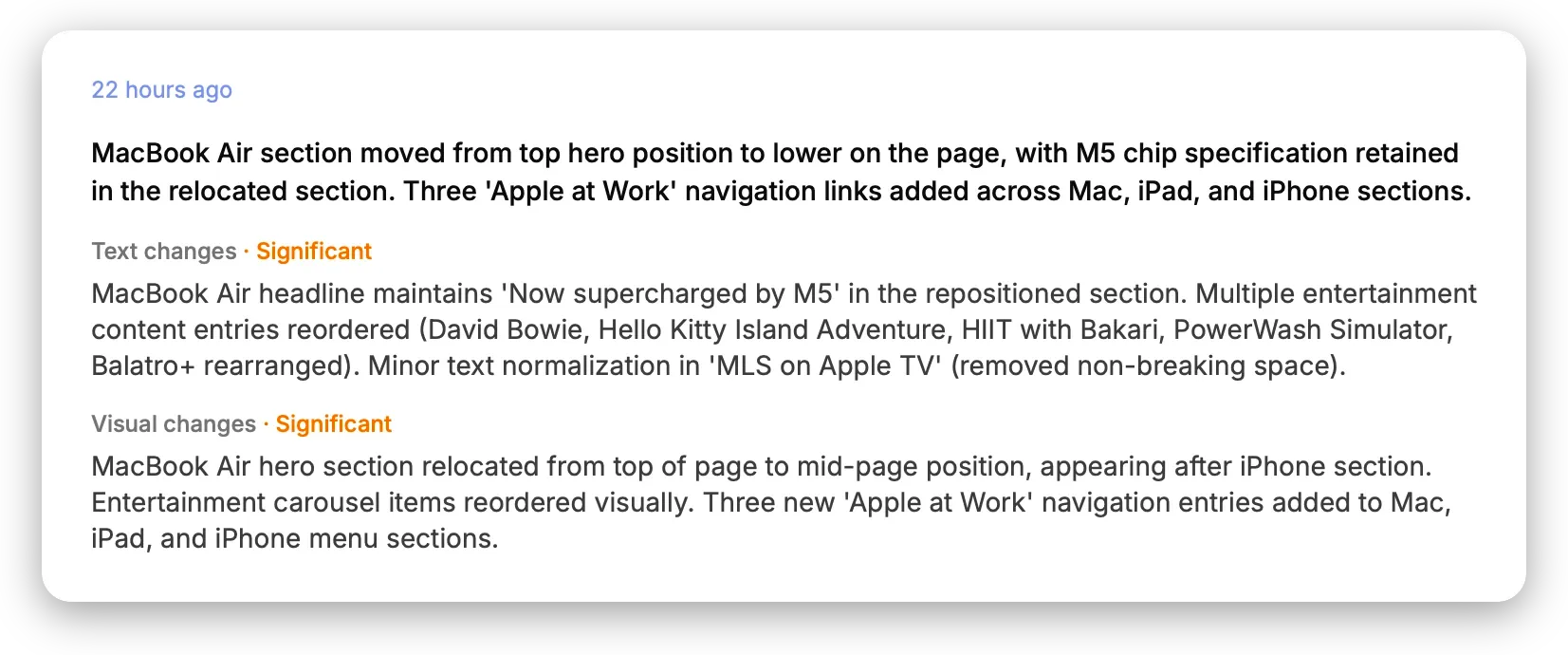
You get a judgement, not a detection. Every change comes back as a plain-language summary of what actually happened, graded by significance. Hexowatch archives a snapshot and shows you the comparison, which is precise and completely fine for one page. Across thirty, the work shifts from spotting the change to deciding which ones deserve a look, and that’s the work a score does for you.
Every plan is fully featured. Hexowatch tiers capability: webhooks, integrations, custom actions and the API begin at $29/month, and choosing where checks run begins at $55. Its free tier has no integrations at all. PageDiff plans differ only by scale, in monitors, checks, interval and retention. Slack, Discord, signed webhooks, AI summaries and significance scoring are on Starter.
EU hosting, in writing. PageDiff is an EU company hosting in the EU, and the subprocessor list is public. Hexact, Inc. is a US corporation that says it primarily stores information in the United States, with Delaware governing law, arbitration and a class-action waiver. Both answers are legitimate. They’re just answers to a compliance question that some buyers have to answer in a specific way.
Where Hexowatch wins outright
- Coverage. Thirteen monitor types against one. Uptime and availability, API endpoints, WHOIS records, backlinks, tech-stack changes, RSS feeds and sitemap monitoring for newly published pages are all things PageDiff has no answer for.
- Pages behind a login. Custom actions can type credentials and submit a form as part of the check. PageDiff only reaches what is publicly reachable, so if your target needs an account, this comparison ended before it started.
- Where the check comes from. Business plans and up let you check a page as if you were in the US, EU or Asia, which is the right fix for a site that localises prices by region.
- More integrations. Telegram, Microsoft Teams, Zapier, Pabbly Connect and Google Sheets export, on top of email, Slack, Discord and webhooks.
- A free tier. Small, at 75 checks a month, but it doesn’t ask for a card.
- A three-month retention floor on every plan, which is longer than our Starter’s 30 days.
- Sitemap monitoring for whole-site coverage, and bulk URL setup. PageDiff is one monitor per page.
If any of those is the reason you’re looking, Hexowatch is the tool.
Worth knowing either way: Hexowatch’s FAQ says it isn’t designed to monitor social networks, search engines or large marketplaces like Amazon and eBay. Those sites defend themselves against automated access, and we’d rather say plainly that they’re hard for everyone than imply we’ve solved them.
Detection, or reading
If the problem is that you can’t catch the change, Hexowatch is the more complete product and the gap isn’t close. Thirteen monitors, logins, regions, uptime and WHOIS in one account.
If the problem is the twenty emails a week that all say a change was detected, that’s the one PageDiff was built for. You describe what matters, and each alert tells you what changed and how much it matters, in a sentence you can read from your phone.
Point PageDiff at a page you actually care about below, no account needed, or compare the plans.
Try PageDiff on any page
Paste a public URL to see the live capture and the watch conditions PageDiff suggests, right here, no signup.